
What a beautiful pairing: clay, one of the oldest building traditions in the world, and winegrowing, one of the most deeply rooted agricultural practices in our history. If the taste of wine is tied to the soil in which the vine grows, the atmosphere of the rooms where we enjoy it also depends on the materials that make them up. At the Simon Huber Winery and Wine Bar, both traditions come together to offer a unique experience.
The history of this winery begins beside the Benedictine abbey of Gengenbach, in the heart of the Black Forest, where the monks already grew their own wine. Today, Julia and Simon Huber take up that legacy and project it into the future with a concept that combines winemaking excellence and innovative architecture.
Their tasting room is a contemporary interpretation of everything that gives this land its identity: the building tradition of the Black Forest, the spirituality of the monastic town and the strength of the soil itself, origin of the wine.
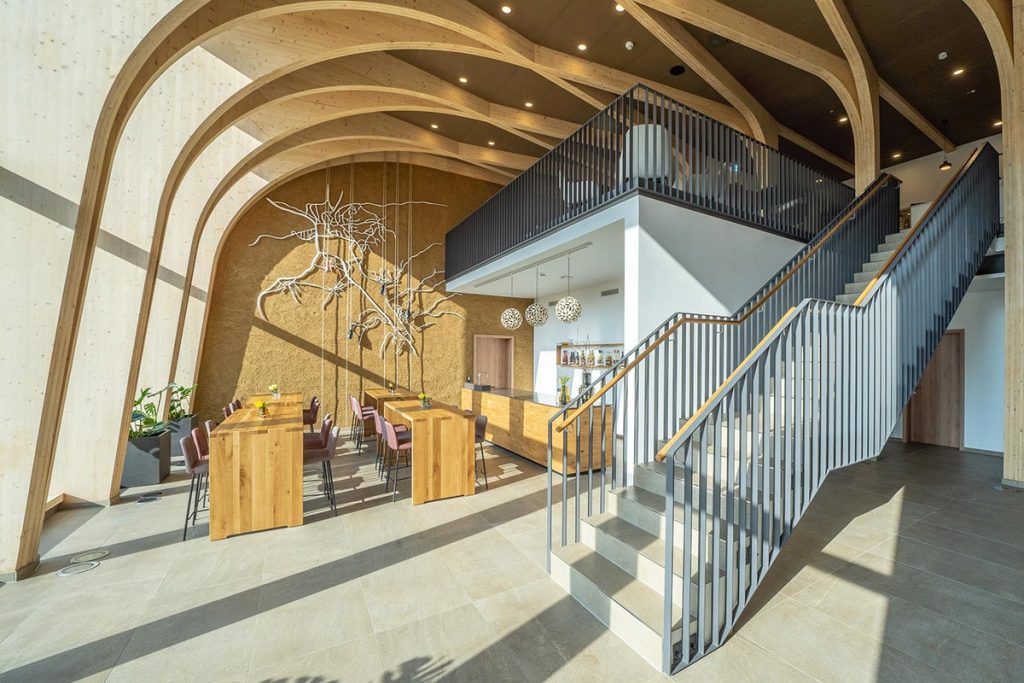
The Huber family has turned a classic Black Forest house into a winery and wine hotel. The extension, designed by the architects Müller + Huber, combines traditional and modern elements:
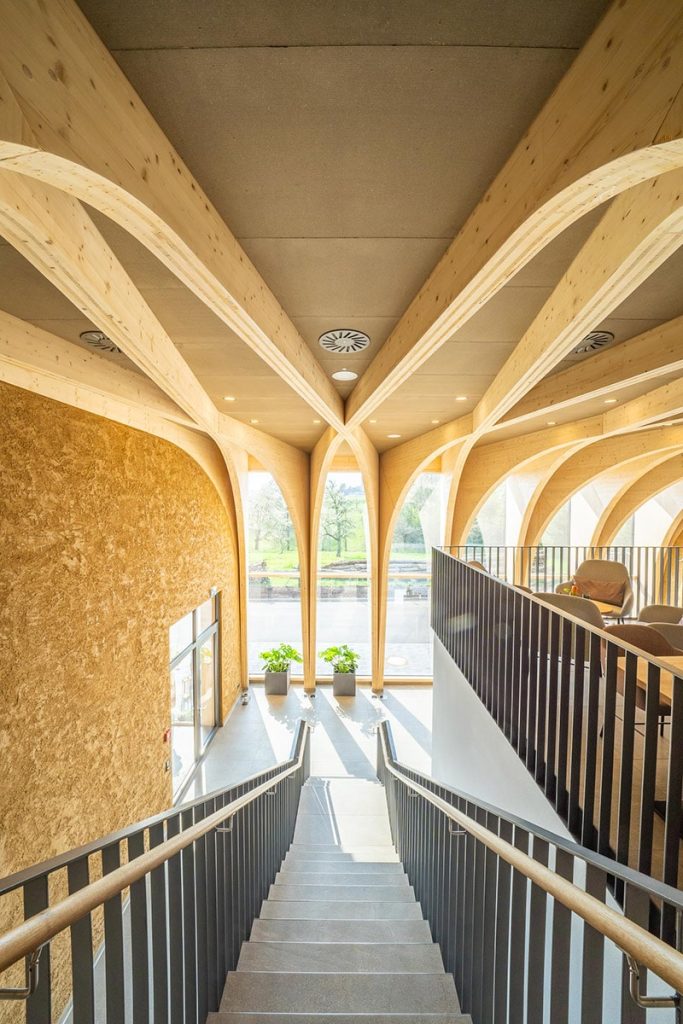
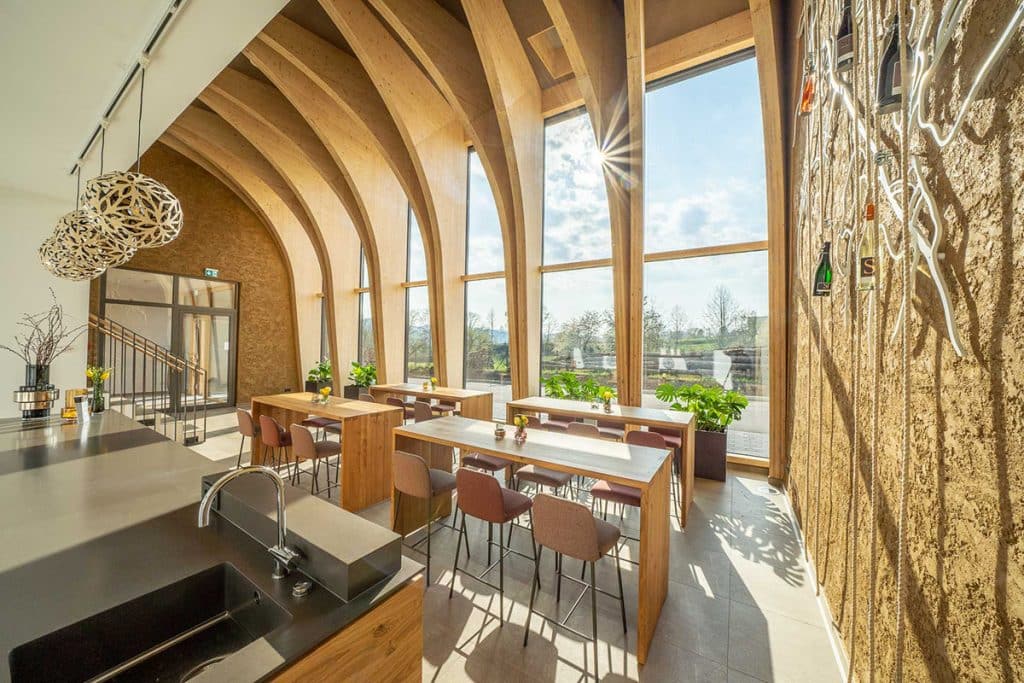
• A timber ribbed vault, evoking the sacred origins of Gengenbach.
• Wooden shingles on the facade, recalling the regional roofs.
• An interior dominated by clay walls, which envelop the visitor in a warm and natural atmosphere.
The entrance area, used as a tasting room and wine bar, opens across two floors, connecting tradition and the avant-garde.
“Many of our vineyards sit on clay. Clay is also a traditional building material,” explains Simon Huber. That coherence takes shape in metre-thick walls, clad with eight centimetres of ClayTec clay plaster, worked with an innovative finish that simulates cracked earth.
Against this earthy background, a work of white lines evokes the roots that run through the subsoil to nourish the vine. Thus the circle is complete: from the soil to the wine, from the wall to the glass.
The design of the walls was developed by master plasterer Thomas Glück, who created the artistic surface known as Blackforest-Line. Its archaic look recalls fresh earth and lends an unmistakable character to the wine bar.
To achieve this effect, ClayTec materials were used in different phases:
• ClayTec clay adhesive and reinforcement mortar, as surface preparation.
• ClayTec clay mortar with straw, sprayed onto the concrete walls.
• ClayTec Mineral 20 clay plaster, applied as the final coat.
• Kreidezeit beeswax-based glaze, which provides natural protection and impregnation.
The result is a masterful example of how tradition, craftsmanship and bioconstruction can transform a space into an experience.
Architecture: New build
Use: Winery and wine hotel
Architecture studio: Architekturbüro Müller + Huber
Craftsmen: Glück GbR Lehmbau
Location: Mattenhofweg 3, 77723 Gengenbach, Germany [Google Maps]
The Simon Huber Winery and Wine Bar reminds us that tradition and modernity are not at odds, but can come together in harmony thanks to clay. This material, present both in the soil that nourishes the vines and in the walls that welcome the visitor, turns the experience of wine into something more than a taste: into a dialogue between earth, architecture and culture.
At Claytours we continue to explore spaces where clay not only builds, but also connects cultures, territories and senses.