

By Rafael Cintora, CEO of RedVerde
On 3, 4 and 5 June, Málaga hosted Málaga Bio, the first national gathering on prefabricated and industrialised green building, and I had the honour of taking an active part as a speaker, workshop leader and stakeholder through RedVerde and Club Madera.
This event, organised by Cesefor and the Málaga Provincial Council, and with the support of institutions such as Málaga City Council, the Regional Government of Andalusia, the Málaga College of Architects and the “La Caixa” Foundation, has marked a turning point in the conversation about sustainability, industrialisation and the future of construction in our country.
From round tables to hands-on workshops, from speed-chatting between companies to visits to real building sites, Málaga Bio brought together professionals, institutions, manufacturers and specifiers around a common goal: accelerating the decarbonisation of the building sector.
This is my personal and professional account of what we experienced during these three intense, inspiring and necessary days.
The first day of Málaga Bio made it clear to us that talking about timber construction today is not a trend: it is a necessity and a reality. From the very start, it was evident that wood is not only a fine material by virtue of its natural origin, but the best ally for decarbonising the construction sector. This was affirmed by leading voices from the industry who shared their experience with a shared conviction: we are at a turning point.
This day set out three major advantages of wood over other materials. First, its low carbon emissivity: being a natural resource, the processes of transforming wood consume far less energy than those of steel or concrete. In addition, during their growth, trees capture CO₂ that remains stored in the buildings throughout their service life.
Second, the ease with which wood can be industrialised as a material was highlighted and, by extension, so can timber building systems. The move from artisanal work to prefabricated construction makes it possible to improve completion times, reduce waste, ensure consistent quality and control the processes from the factory. This is especially relevant at a time when we need fast, efficient and sustainable solutions to the serious problem of access to housing.
The third advantage has to do with energy efficiency: timber systems are compatible with low-energy designs, which makes them the ideal basis for building passive or nearly zero-energy buildings. But beyond the technical side, wood was championed as a tool for regenerating regions, fighting depopulation and training people who can work in their own community. An opportunity for roots, employment and sustainability.
The cultural and economic barriers that still hold back the expansion of wood were also addressed, such as the fear of fire —more than overcome by the performance of engineered timber— or the perception that it is a more expensive option. In this respect, recent inflation has levelled the costs, and many pioneering projects, such as Oceánika in Málaga, show that building in timber today can be just as competitive and far more beneficial.
What we saw during this day was the emergence of a new way of looking at things: it is not just about changing the material, but about changing the way we build, design and inhabit. As was said during the talks, when we let go of fear and read good architecture again, we also read nature, and that changes everything.
At RedVerde, we are delighted to be part of this change and of a professional community that is managing to look to the future with courage, technical skill and enthusiasm.
The second day of Málaga Bio continued at the La Noria Social Innovation Centre, in the Miraflores district.
The morning began with an in-depth session on the transition towards greener construction. Figures such as Jorge López (NEB), Carlos Llibre (011h) and Ana Carvajal (Arquima) debated new building models, energy efficiency and the circular economy, making clear the urgent need to evolve architecturally.
My contribution to the panel on forest biomass with Gabriel Gutiérrez, Javier Calvo and Edgar Lafuente highlighted the future Horizon project to be developed together with Cesefor and the Málaga Provincial Council, and its vision of using local biomass to manufacture boards and structural elements based on unused forest waste, with industrial and rural impact.
It was stressed that, when things are done well, activating existing industry and backing technical knowledge, industrialised timber construction competes on price with conventional methods. But the advantages go far beyond cost: we are talking about health for those who will live in the spaces, greater quality control, predictable timescales and a notable improvement in working conditions on site.
Industrialised processes make it possible to build standard 200 m² homes in 5 days of factory construction and another 5 of on-site assembly. If we add the time spent on finishes, a home ready to live in is delivered in 4 to 6 months. This figure —which drastically reduces the usual timescales— is especially relevant for developers, since reducing construction time has a direct impact on the economic profitability of projects.
Today, building in timber costs the same as building in concrete. The figures are around €1,400–1,500 per square metre. And those who have built with both systems confirm it: wood not only competes on price, but also brings added value to the end user.
However, the current reality in Spain is that only 1% of industrialised construction uses timber or bio-products. In other European countries, such as Sweden, this figure reaches 90%. In France, Germany or Austria, it is between 30 and 50%. To meet the projected demand for housing by 2030, that figure would need to be multiplied exponentially.
Even so, there was a sense of optimism: Spain already has professionalised companies developing high-quality products with the capacity to scale up. The need to adapt timber value chains to regional particularities was also addressed.
Projects were highlighted such as those of Nasuvinsa in Navarre —especially the building in Mutilva and the Garralda project— or the case of the Balearic Housing Institute, which is backing native and waste materials such as posidonia to achieve acoustic solutions in timber.
The day made it clear that wood is no longer a material of the past, but a lever for innovation towards more industrialised, more human, more balanced construction. Hybrid products, such as timber-concrete floor slabs, are presented as the way to build confidence and generate viable technical solutions for all kinds of work.
The speed-chatting session was a hotbed of connections between companies driving the cutting edge and commitment:
Finally, at RedVerde we had the opportunity to contribute an essential piece within the ecosystem of eco-friendly construction: knowledge of non-toxic natural coatings and finishes, natural paints and eco-friendly products designed to protect and beautify wood without compromising health or the environment. We shared our experience with materials that, as well as being sustainable, respect the breathability of building elements, improve indoor comfort and extend the service life of timber systems. We were able to explain how these finishes fit into an approach consistent with the whole life cycle of the building, from the choice of materials to their maintenance. It is a field that, although it often stays in the background, is key to guaranteeing that construction with biomaterials is truly healthy and aligned with the principles of green building
The afternoon was devoted to hands-on demonstrations and networking around innovative building systems.
The session began with the award of diplomas to the students of the course on “Industrialised construction with timber”, organised by Maderaula and the Málaga Provincial Council and funded by the “la Caixa” Foundation. A recognition of the effort of those who are already training to build a more sustainable future.
Next came various technical demonstrations that allowed many of the ideas discussed during the event to be seen in action.
In an upcoming post we will share in detail our demonstration with eco-friendly finishing products, an experience that connected us with what is essential: building with health, contemporary technical skill, beauty and awareness.
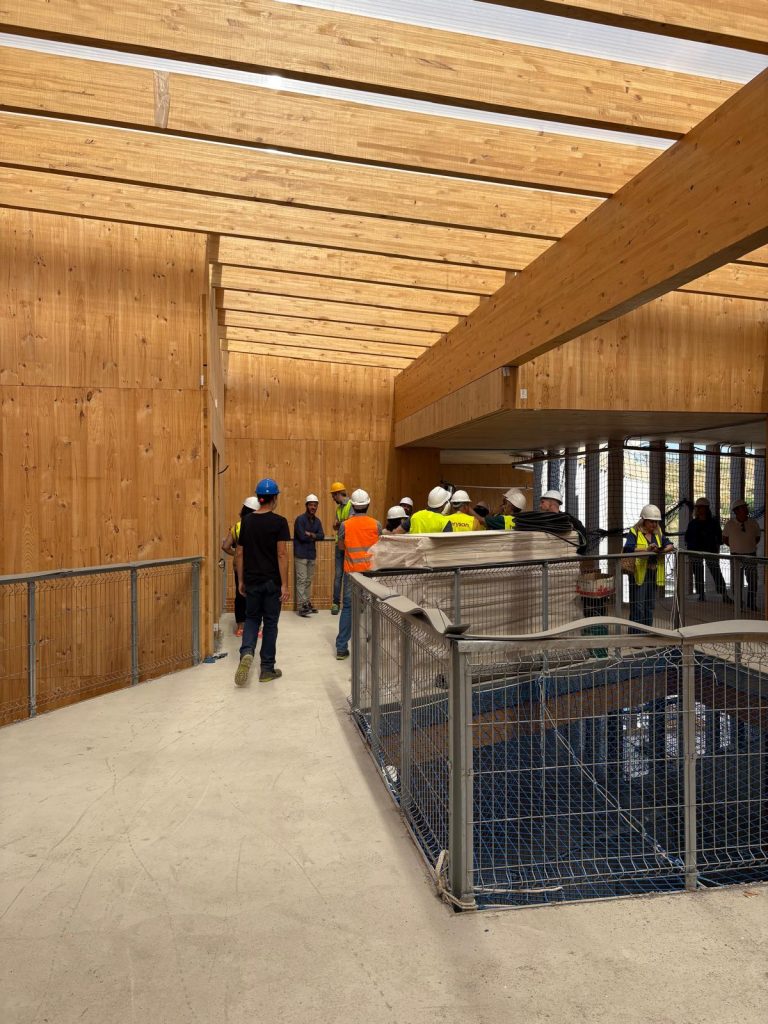
We travelled to the building sites to attend the real assembly and execution of two works in progress.
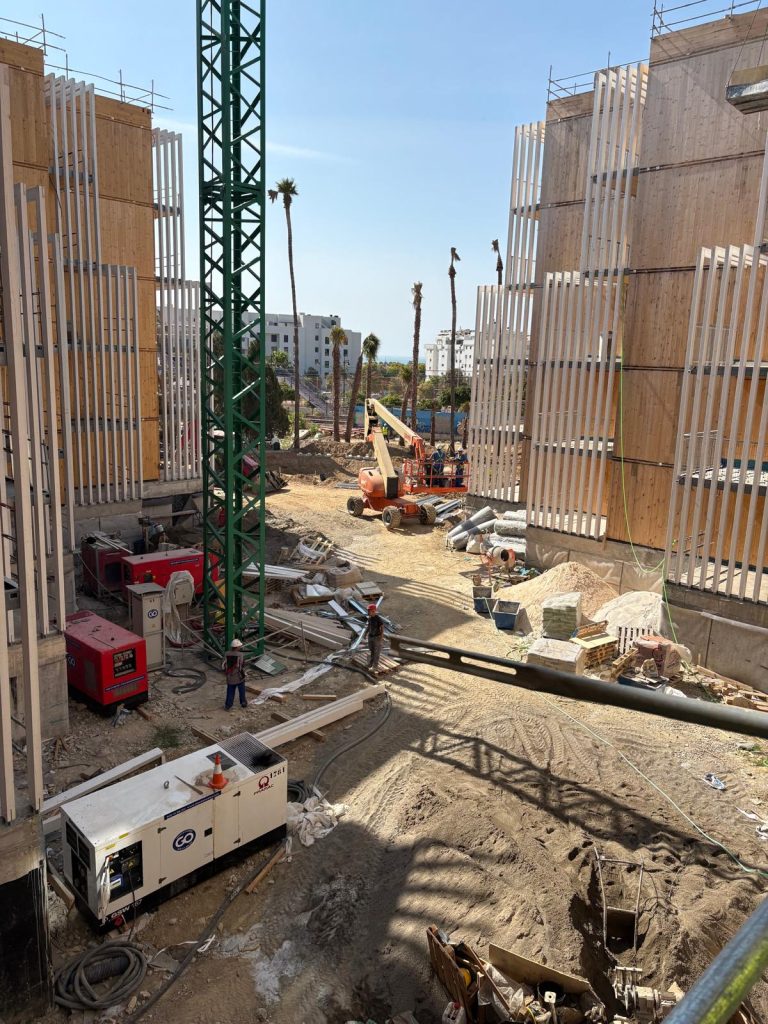
Oceánika, located in Torremolinos, has 180 apartments spread over five storeys, and stands as a benchmark in sustainable, industrialised architecture thanks to the use of the CLT (cross-laminated timber) system. This innovative proposal not only backs the decarbonisation of the sector, but also gives value to bioclimatic design, energy efficiency and the digitalisation of building processes. Conceived from the outset to be a timber building, Oceánika stands out for its low environmental impact, its ability to reduce completion times and for offering a healthier, more comfortable environment for its future residents.
Then, we visited the impressive Karl Lagerfeld Villas. Located on the prestigious Golden Mile of Marbella, this project consists of five unique villas that pay tribute to the creative legacy of the German designer. Each home has been conceived with a holistic approach that prioritises energy efficiency, the use of natural and recyclable materials, and harmonious integration with the surroundings, achieving a perfect symbiosis between aesthetics, sustainability and technology.
From a personal and professional point of view, I can say that Málaga Bio was not simply a succession of conferences: it was a transformative experience. A real demonstration that the union between the ancestral —the traditional use of wood, clay and the knowledge of each region— and the most cutting-edge industrialisation is not only possible, but desirable and urgent. It is the logical path if we want a competitive building model that is truly aligned with the climate and social challenges of the present.
Málaga Bio has acted as a catalyst for a dynamic that can no longer be postponed: close collaboration between public actors, institutions, industry, training and research centres, to weave a new horizon in building based on wood and biomaterials. It has been inspiring to see how different voices and backgrounds converge on a common vision.
At RedVerde we come away reinforced, motivated and with new alliances that drive us to keep contributing technical solutions, strategic collaborations and rigorous outreach. Our commitment is clear: we want this model to spread, to become professionalised and to establish itself as a real alternative throughout Spain. Because it is not just about building better, but about building the future.