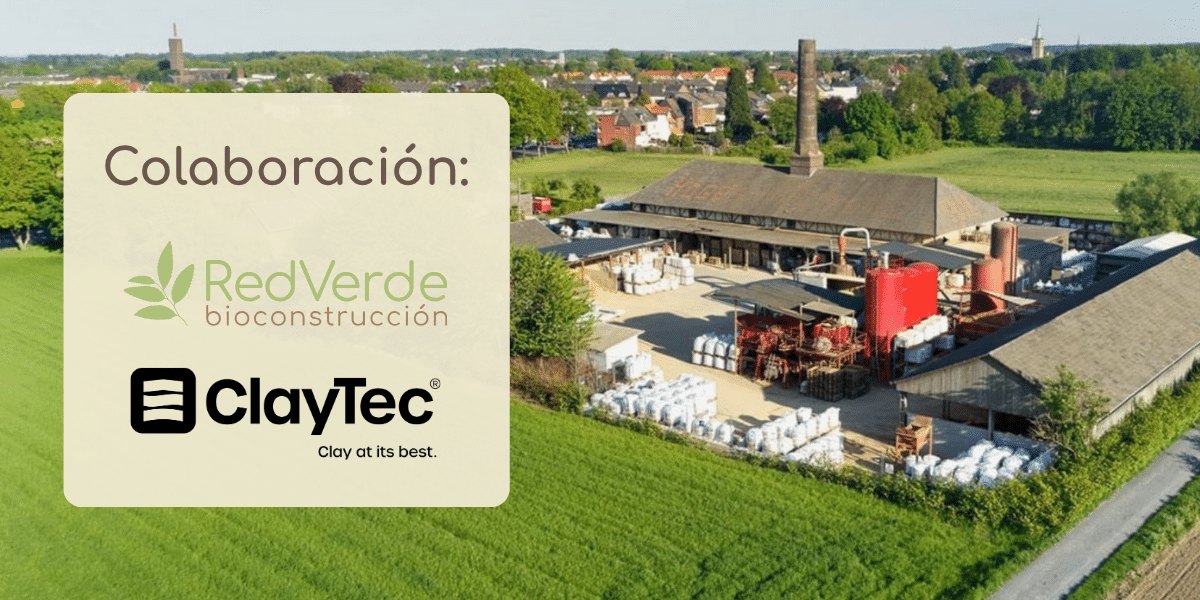
When we talk about sustainability in construction, it’s easy to think of new trends. But some projects have spent decades paving that path. One of them is ClayTec, a German family company with deep roots in traditional construction and a firm commitment to natural materials. This is its story, told from the first handful of clay to becoming an international benchmark.
The history of the ClayTec company
The story of ClayTec began in the 1970s. Peter Breidenbach comes from a family of architects closely tied to traditional construction. His parents worked mainly in the field of heritage conservation, and in 1975 they privately began renovating a timber-framed farmhouse dating back to 1661.
At that time it was not yet fashionable to build with natural materials and, therefore, materials suited to heritage. The era of unlimited faith in progress still prevailed. After 1945, the construction sector had undergone a profound boom in industrialization.
Craft-based construction methods were ridiculed. However, from the perspective of renovating timber-framed houses, traditional building materials were not considered backward at all. In 1978, at the Tho Rieth Hof in Viersen, the first attempts began to prepare clay for infill and plastering. The earliest experiences in building with clay date back to this period. Peter Breidenbach was 15 years old; his schoolfriend Ulrich Röhlen a few years older.
How it all began
The entrepreneur
After finishing secondary school, Peter Breidenbach was drawn not to academic study but to practice. By the early 1980s, many people were already interested in authentically renovating timber-framed houses and in trying alternative building methods for new constructions. Again and again, attention turned to clay as a building material.
However, the logistical, mechanical and personnel infrastructure was lacking. This was the gap in the market. So, at the age of 21, Peter Breidenbach founded the construction company Lehmbau Breidenbach and took on his first major building contract.
With the support of friends from the fields of heritage conservation, culture and academia, the question of craft-trade law was clarified.
In 1985, the company was entered in the register of craftsmen of the Düsseldorf Chamber of Crafts, becoming the first company dedicated to earth building in Germany.
From the outset, Lehmbau Breidenbach had its own specially designed machines. They had to be newly developed. Modern mechanized earth building had never existed before. Suitable employees also had to be found. Among them was Ulrich Röhlen, who had meanwhile begun studying architecture in Aachen.
Lehmbau Breidenbach: The year in the construction sector
Since in the 1980s building contracts were still spread across all of Germany, earth building meant working away from home. Monument renovations were located mainly in the low mountain ranges, with their characteristic timber-framing culture. When it came to new builds, the location was defined by pioneering builders.
Over time, out of the multitude of possibilities emerged earth building methods suited to the construction tasks of the present. In timber-frame construction, traditional infill methods were complemented with clay block masonry. Light loam was used as interior insulation in old buildings and as exterior infill of walls for timber frames in new buildings.
It became clear that loam was less in demand for the framework of new buildings than for the finish. Clay plaster became the most important field of application, and more and more builders were won over by its experiential qualities in terms of a liveable indoor climate and appearance.
This, however, entailed a major organizational effort: clay, sand and straw had to be available on the building site in the right quantities, along with a powerful supply of water and electricity.
The company took part in the renovation of important timber-framed town houses. A notable example is the Römer 2-4-6 house in Limburg, built in 1289 and considered the oldest timber-framed house in Germany at the time of the renovation.
Among the new-build projects, the eco-social housing development of Cologne-Chorweiler stands out, a complex of 18 large timber-structure buildings.
Evolution
1978: Tho Rieth-Hof, the beginnings
In 1975, the parents of the company’s founder, Peter Breidenbach, acquired a 16th-century timber-framed house, the Tho-Rieth-Hof in Viersen. Here they developed almost all earth-building techniques on their own construction project.
1984: Founding of the company
Peter Breidenbach founded the company Lehmbau Breidenbach on 1 April 1984, just after completing his secondary-school studies. The first equipment for producing clay mixes was quickly developed.
1985
Entry in the commercial register
Peter Breidenbach was the first clay builder in Germany entered in the register of craftsmen. The application was supported by numerous heritage authorities.
Mechanization of clay-plaster processing
Clay and straw are not raw materials that can be processed with standard construction equipment, so a high-performance industrial mixer from Eirich was mounted on a construction trailer.
1984–1991
In the following years, the company grew continuously. With up to 30 employees, in as many as 5 columns, Lehmbau Breidenbach travelled across all of Germany.
1990
The brickworks
In Viersen, the city completed the restoration of the former brickworks under the direction of the architect Inge Breidenbach. Lehmbau Breidenbach moved in as a tenant.
Manufacturing of building materials.
Centralized production of earth building materials was launched, and experiments began again with machines and systems that had actually been designed for other purposes. The first earth-building-material production plant was gradually built.
1992: ClayTec, registered trademark
Clay building materials are sold to the trade, to craftsmen and to end customers under the registered trademark ClayTec.
1993: Training courses
So that our customers don’t have to reinvent the wheel, training courses are organized at the company’s premises. These events would be expanded in the years to come.
1996: The clay boards
The clay building board is a milestone in the development of modern clay building materials. Building with clay has finally reached dry construction, opening up new applications in building.
1997: The monument protection award
Thanks to the work of the company Lehmbau Peter Breidenbach, the historic material clay-rich earth has been reused by hand for the conservation of historic monuments. This work has been recognized by the German National Committee for Monument Protection.
2000–2008: The expansion
The production area became too small. A new hall was built for the production and storage of ClayTec clay building materials.
2000: The commercial structure
The decision was made to offer ClayTec clay building materials exclusively through specialist construction trade. The trade remains closely involved through associations.
2008: The new production plant
The old production plant, growing slowly, reached the limit of its capacity. A completely new plant was designed and built. All the experience gained in previous years was incorporated into it
2009
The Kolumba Museum
ClayTec clay building materials are used across several thousand square metres of the Kolumba Museum in Cologne, proving that clay, an ancient material, is ideal for high-quality aesthetic surfaces.
The Westerwald branch.
The Koblenz branch opens near important raw-material deposits in the Westerwald and thanks to its favourable location in terms of transport links. The move to the current location in Ransbach-Baumbach takes place in 2012.
2010: YOSIMA
The YOSIMA product line was presented at the FARBE trade fair in Munich in 2010 as the successor to the fine clay plaster CLAYFIX and textured plaster. A unique colour system!
2011: Egeln in the lowlands
The Egeln branch, near Magdeburg, is founded to ease the production load on Viersen and Ransbach-Baumbach and to better reach the eastern German states.
2013: The dry-mortar plant
A production plant for dry clay mortar is built in Ransbach-Baumbach. The range of ClayTec clay plasters is expanded.
2015: The next generation
The next generation joins the family company. After studying business administration, his son Maximilian takes charge of the logistics, international and IT departments. In 2016, he becomes managing director of ClayTec Lehmbaustoffe.
2020: Cellco under the ClayTec umbrella
As a manufacturer and producer of clay-based building materials, we at ClayTec acquired the long-established company Cellco GmbH (formerly Haacke Cellco).
With the acquisition of Cellco as a manufacturer of insulating materials made from cork and clay, at ClayTec we are getting involved where the history of our Viersen-based family company once began: in the restoration of timber-framed houses.
Today, the company is still defined by its strong connection to the traditional construction sector, which is why Cellco fits perfectly into one of our areas of specialization at ClayTec.
2020: Experience clay live: new with CLAYTOURS
Experience clay; at ClayTec we make it possible with our CLAYTOURS platform. CLAYTOURS offers a carefully selected collection of architectural objects in which clay has been used in a wide variety of building materials.
Our goal is to showcase publicly accessible buildings such as restaurants, wineries or hotels where ClayTec products have been used, and thus to offer a platform where those interested can find objects in which to experience and touch clay building materials and surfaces.
2021: Natural expansion of the company.
The foundation-stone-laying ceremony for the natural expansion of our company’s premises in Viersen has concluded. In June 2021 the long-awaited expansion of the plant at the historic production site, the so-called ring kiln, began on Süchtelner Straße.
The first step is the archaeological investigation of the site, as it borders a historic Roman road. After about five months, the new exit is finally open to traffic.
2021: New production centre in southern Germany
Shortly before the turn of the year, Peter Breidenbach, founder and Managing Director of ClayTec, announces good news: the family company is expanding to Bächingen, in the Swabian district of Dillingen an der Donau, in southern Germany, where it opens another production centre.
The new ClayTec branch will be used in future for the production of wet clay plasters and for logistics tasks.
2022: Founding of the Clay Building Materials Industry Association
In mid-November, the Clay Building Materials Industry Association was founded in Berlin.
The founding members, the companies ClayTec, Hart Keramik and Lehmorange, have set themselves the goal of representing the interests of the mid-sized clay building materials industry, promoting the technical development of unfired clay building materials and their production, and supporting the building-authority approval process.
Maximilian Breidenbach, authorized signatory of ClayTec GmbH & Co. KG, was appointed chairman of the board.
2023: Simon Breidenbach takes over sales management
After the brand was founded in the early 1990s, ClayTec began selling directly to end consumers, craftsmen and commercial companies.
From the year 2000, deliveries were made exclusively through the building materials trade. Committed distributors were grouped into the ClayTec partner distributor network.
Over the years, they were all introduced to the subject by Ulrich Röhlen as sales director and subsequently supported personally to a large extent.
From January 2023, Simon Breidenbach will take on the role of Sales Director of ClayTec.
In short, ClayTec represents a unique combination of tradition, innovation and sustainable commitment. From an old 17th-century house to modern production plants and logistics centres, its journey shows that it is possible to build with earth in a professional, efficient and aesthetic way.
At RedVerde, we value and share this vision: building from the natural, with deep roots in history, but always looking to the future.