

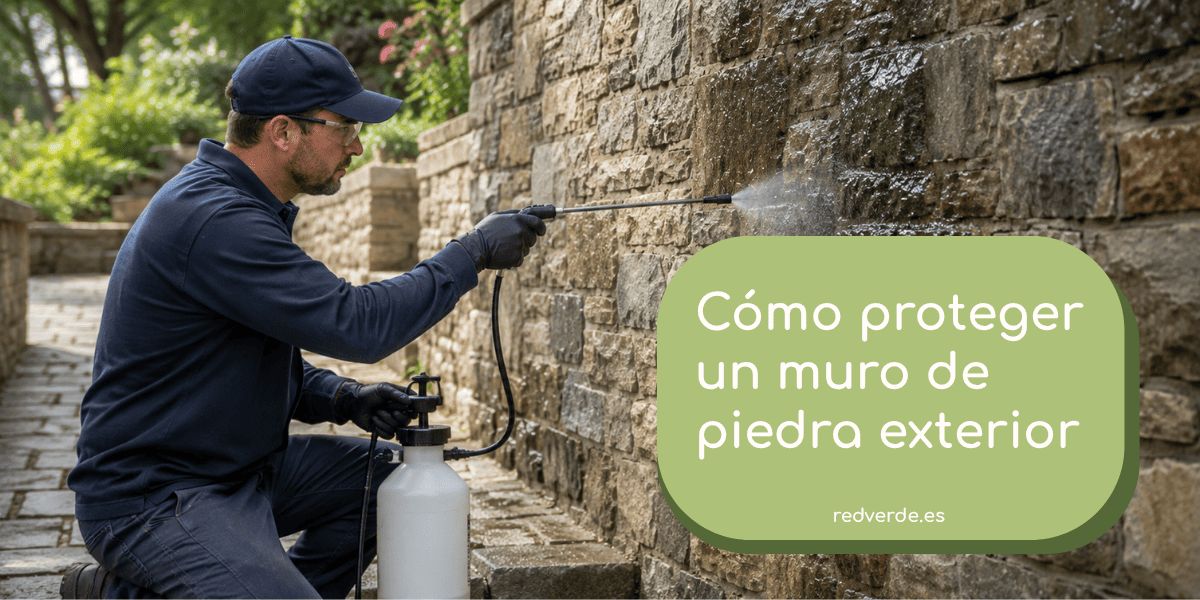
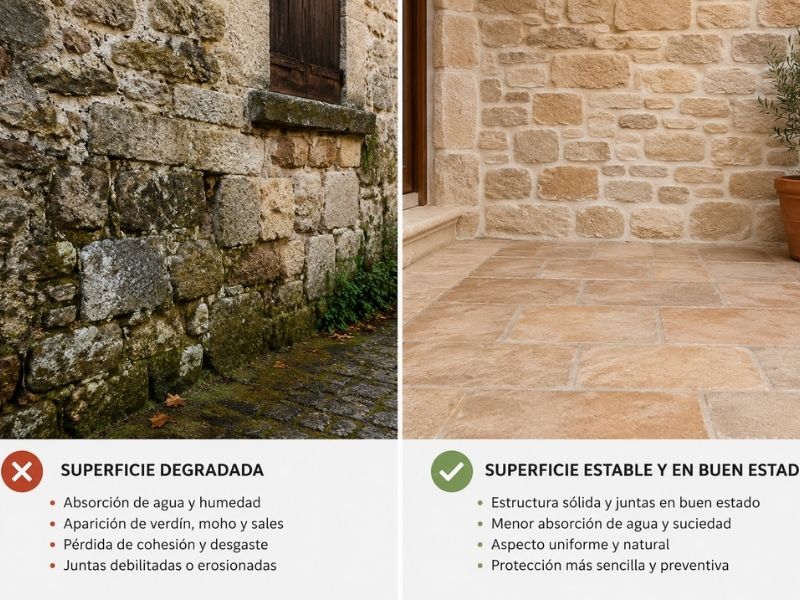
Natural stone and terracotta are porous materials that can absorb water, dirt, and different pollutants from the environment. Outdoors, this continuous exposure can promote the appearance of verdigris, salts, stains, loss of cohesion and surface wear. Indoors, especially in floors and frequently used areas, the main problem is usually the penetration of liquids and dirt.
Proper protection helps reduce these effects, but not all surfaces need the same treatment. An old wall with weakened joints requires a different intervention than a stable stone or a terracotta floor in good condition.
Therefore, before applying any product it is necessary to assess:
Based on this diagnosis, it will be possible to decide whether the surface needs a complete protocol for sanitization, consolidation and waterproofing or, on the contrary, a specific protective treatment against water, dirt and stains.
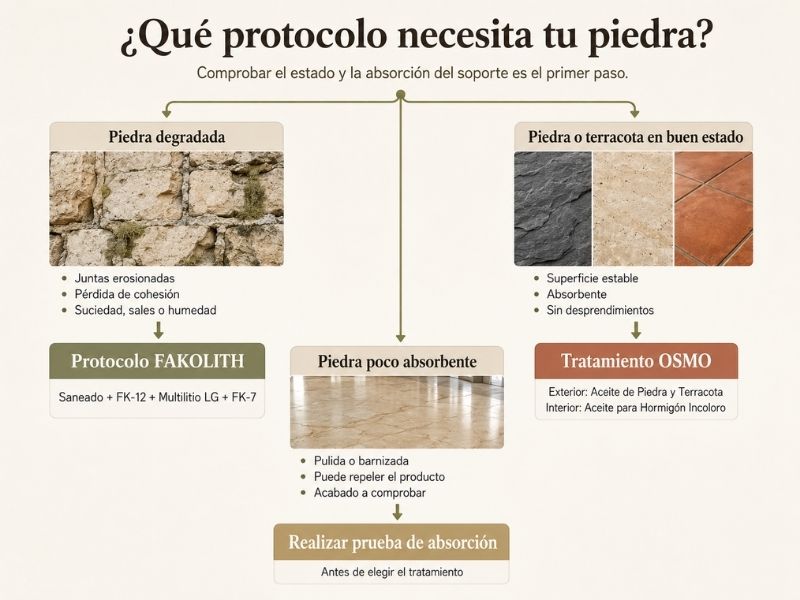
One of the most frequent mistakes is to choose the treatment solely by the name of the stone. Two surfaces of the same material may need different solutions depending on their porosity, finish, exposure and state of conservation.
This protocol can be useful in decorative elements, facades, walls and pavements made with common materials such as:
Limestone, sandstone, granite, marble and slate are among the main families of natural stone used in architecture, cladding and flooring.
However, the treatment will depend mainly on the actual surface conditions.
What should we check?
Before applying any product, it is advisable to check:
Degraded stone or stone with weakened joints
When there are detachments, loss of cohesion or eroded joints, it is not enough to apply a protective product.
In these cases, it will be necessary to clean up the surface and assess a cleaning, mineral consolidation and waterproofing protocol such as the one recommended by Fakolith.
Stable and absorbent stone
When the stone or terracotta is in good condition and the aim is to protect it against water, dirt and stains, an impregnation treatment such as OSMO oils can be used.
OSMO Stone Terracotta Oil is especially aimed at microporous surfaces of natural stone, artificial stone and terracotta. The manufacturer expressly mentions applications on granite, limestone and slate.
Attention to poorly absorbent surfaces
Treatments must penetrate the support. Therefore, a highly polished, previously varnished, waxed or treated stone may have insufficient absorption.
Before intervening, it is advisable to carry out a test in an inconspicuous area and check:
This check will make it possible to decide whether the surface needs the full Fakolith protocol or protection using OSMO products.
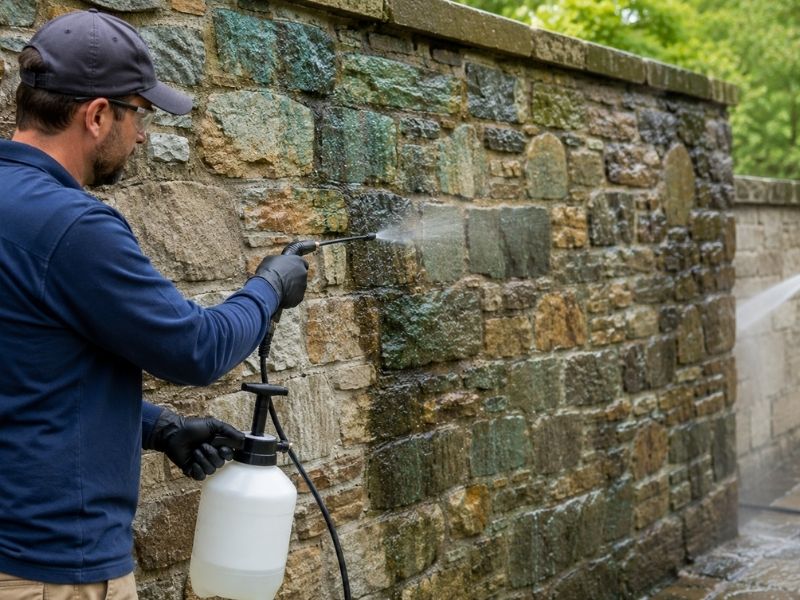
The exterior stone can accumulate dust, pollution, verdigris, microorganisms, salts and remains of degraded materials. If these impurities are not removed, consolidating, water-repellent or protective treatments can penetrate irregularly and lose effectiveness.
This problem is common in walls, facades and decorative elements made of limestone, sandstone, travertine, slate, granite, unpolished marble, artificial stone and terracotta.
Pre-Surface Sanitization
Before starting cleaning, the materials that are:
A consolidating product cannot recover a part of the support that has already completely lost its properties. Therefore, sanitation must always precede cleaning and protection.
Cleaning with FK-12
When the surface has greenery, microorganisms, salts, contamination or stubborn dirt, it can be cleaned with Fakolith’s FK-12 detergent cleaner.
The recommended protocol consists of:
The approximate yield is 5 to 7 m² per liter of concentrate, although it can vary depending on the porosity and condition of the stone.
The water pressure must be adjusted to the strength of the support. In soft stones, old joints or eroded surfaces, excessive pressure could lead to further material losses.
Also in preparation for OSMO treatments
Cleaning with FK-12 can also be used as a pre-treatment step with OSMO products when the stone or terracotta is stable, but has dirt, greenery or contamination.
Outdoors, the subsequent treatment can be carried out with OSMO Stone and Terracotta Oil, suitable for microporous surfaces of natural stone, artificial stone and terracotta.
Indoors, for stone, concrete and other absorbent mineral surfaces, OSMO Colourless Concrete Oil can be used.
Before applying any of these treatments, it is essential to:
If the stone is clean, stable, and free of contaminants, the use of FK-12 may not be necessary.
Pre-test on sensitive stones
In marble, polished granite, previously waxed stone, varnished surfaces or poorly absorbent materials, it is advisable to carry out a test in a discreet area.
This check will make it possible to assess whether cleaning alters the finish and whether the surface is prepared to uniformly absorb the subsequent treatment.
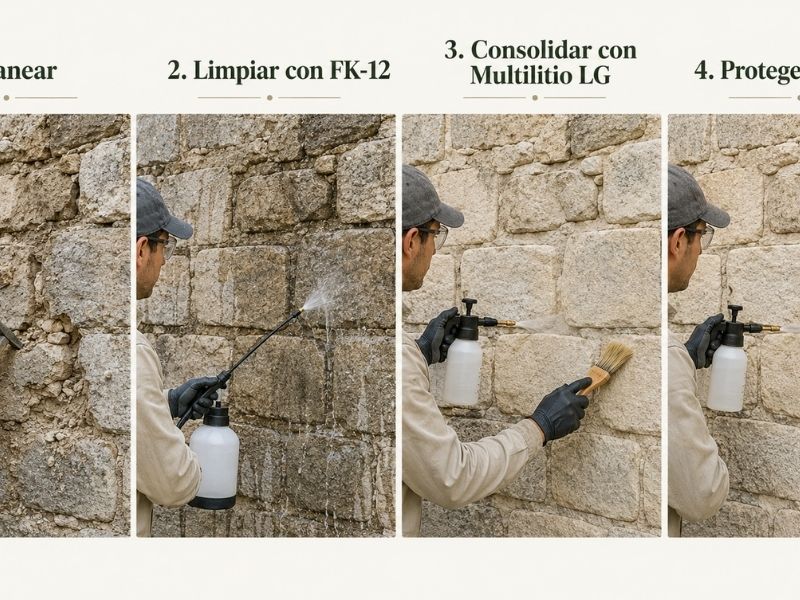
When a wall has weathered stones, eroded joints or loss of cohesion, applying only a protector does not solve the problem. It is first necessary to remove the deteriorated materials, clean the surface and recover the solidity of the mineral base before protecting it from rainwater.
This protocol is designed for walls and facades of absorbent mineral stone, such as limestone, sandstone, travertine, porous granite, slate, unpolished marble or certain artificial stones.
Step 1. Cleaning up deteriorated areas
Loose, non-adherent or advanced decomposing materials will be removed. These parts have lost their properties and cannot be recovered by consolidating treatment.
The condition of the joints between the stones should also be checked. When they have lost too much material, the most complete solution will be to clean them up and fill them with a compatible lime mortar.
Step 2. Clean with FK-12
After sanitization, cleaning will be carried out with Fakolith’s FK-12 detergent cleaner, following the procedure explained in the previous point:
This cleaning allows dust, microorganisms, salts, contamination and inconsistent material residues to be removed, leaving the pore ready for subsequent treatments.
Step 3. Consolidate with LG Multilithium
When the existing joints are not going to be filled or grouted with lime mortar, Fakolith recommends applying at least two coats of LG Multilithium, in a concentrated state, over the entire surface.
Multilithium is a mineral consolidant based on modified lithium silicate and reinforced with colloidal nanosilicas. By penetrating the mineral base, it helps to increase its hardness, cohesion and robustness without forming a surface film.
Main application data:
This treatment does not rebuild the lost volume of the joints. Its function is to improve the cohesion of materials that are still sufficiently stable.
Step 4. Protecting the wall with FK-7
Once the two coats of mineralization are finished and completely dry, a double cross coat of FK-7 will be applied.
FK-7 is a concentrated consolidating water-repellent, formulated with silanes and siloxanes, which penetrates the absorbent mineral bases and reduces the entry of liquid water while maintaining vapor diffusion. It is indicated for the protection of natural stone, artificial stone, mortars, concrete and other porous mineral materials.
Main application data:
Water repellency helps reduce rainwater penetration. In this way, the risk of successive cycles of absorption and evaporation transporting salts and minerals back to the surface decreases, reactivating the degradation of the wall.
Avoid excesses during application
Both LG Multilithium and FK-7 must be completely absorbed by the mineral base. In no case should the following remain:
Both products can be applied by manual spraying. Immediately afterwards, it is advisable to go over the surface with a brush or a dry roller to distribute the treatment, blur possible marks and remove any excess.
Important: Before treating the entire wall, a sample must be taken in an inconspicuous area. In the case of polished, varnished or low-absorbency stones, it will be necessary to check the compatibility of the system beforehand.
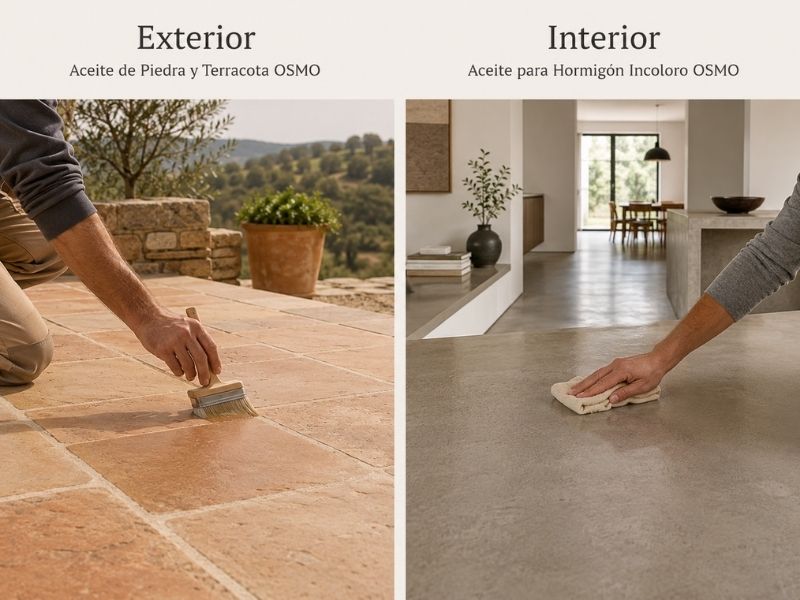
When the stone or terracotta is firm, clean and without loss of cohesion, it is not necessary to apply a consolidating protocol. In these cases, an impregnation can be used to penetrate the material and facilitate its protection and maintenance.
OSMO coatings are designed for microporous and absorbent surfaces. They should not be used to try to recover decomposed stones, weakened joints or walls with detachments.
Step 1. Clean and prepare the surface
The stone should be clean, dry, stable, and frost-free. If it has verdigris, microorganisms, salts or persistent dirt, it can be cleaned beforehand with Fakolith’s FK-12 detergent cleaner, following the protocol explained above.
After cleaning it is essential to:
When the surface is already clean and free of contaminants, this step with FK-12 may not be necessary.
Step 2. Perform an absorption test
Although oils are colorless, they can intensify the natural tone of the stone and provide a satin finish. Therefore, before treating the entire surface, a sample should be taken in an inconspicuous area.
The test will make it possible to check:
Very dense, polished, varnished or waxed stones may absorb little product and need different preparation.
Step 3. Choose the product according to location
Stone and terracotta outdoors
For floors, windowsills and exterior elements, OSMO Stone and Terracotta Oil can be used.
It is suitable for microporous natural stone, artificial stone and terracotta placed outdoors. It is particularly suitable for absorbent granite, limestone and slate, and can be assessed on sandstone, travertine and other porous stones after a pre-test.
The product penetrates the surface without forming a continuous film and improves its resistance to water, dirt and stains. Its indicative yield is approximately 32 m²/l per coat.
Stone and mineral surfaces in interiors
For natural stone, concrete, screeds, artificial stone and unglazed tiles located indoors, OSMO Colorless Concrete Oil can be used.
It is suitable for surfaces such as:
Its indicative yield is approximately 50 m²/l per coat.
Step 4. Apply very thin coats
Both products are ready-to-use, so they should not be diluted. Before applying them, the content must be stirred well.
The general procedure consists of:
In renovations, a single coat on the cleaned and prepared surface can usually be sufficient. The approximate time before applying the next coat is about 8–10 hours, although the technical data sheet and environmental conditions should always be checked.
Prevent oil build-up
The liquid product must penetrate completely into the holder. There must be:
Too heavy an application can delay drying and produce differences in gloss. The goal is to impregnate the stone, not to form a surface layer.
Important: This protocol is suitable for stable, absorbent stone and terracotta. If there is loss of cohesion, eroded joints or decomposed materials, the clean-up, consolidation and water-repellent protocol described in the previous point must be assessed beforehand.
Suggested image: composition divided into two scenes. On the left, application of OSMO Terracotta Stone Oil on an outdoor pavement of terracotta or limestone. On the right, application of Colorless Concrete Oil on an interior mineral surface. In both scenes, a thin, uniform layer should be shown, with no puddles or excessive brightness.
Most finishing problems are not solely due to the chosen product. Insufficient cleaning, damp support or excessive application can reduce the effectiveness of the treatment and lead to stains, differences in gloss or lack of penetration.
Apply to a wet surface
The stone must be completely dry before receiving LG Multilithium, FK-7 or any of the OSMO oils.
Retained moisture can hinder absorption, cause uneven distribution, and lengthen drying times.
Failure to remove degraded materials
Decomposed stones, loose mortars and joints without adhesion cannot be recovered by simply applying a consolidator or a water-repellent.
Before starting, it is necessary to clean the support and remove all the materials that have lost their properties.
Protect without cleaning beforehand
Dust, verdigris, microorganisms, salts, and contamination can prevent uniform penetration of products.
Where these contaminants are present, a pre-cleaning should be carried out with Fakolith FK-12 Detergent Cleaner, followed by thorough rinsing and drying of the surface.
Using an oil on a degraded wall
OSMO oils are intended for stable, firm and absorbent stone and terracotta. They do not replace the sanitation, grouting or consolidation of a deteriorated wall.
When there is loss of cohesion, eroded joints or detachments, the Fakolith protocol should be assessed first.
Confusing consolidation and waterproofing
Consolidation and waterproofing are different actions:
A degraded surface may need both interventions. Applying only a water-repellent does not recover the lost solidity.
Applying too much product
LG multilithium, FK-7 and OSMO oils must penetrate the substrate. There should be no accumulations, runoff, puddles, sticky areas or localized shine.
In Fakolith treatments, it is recommended to immediately go over the surface with a dry brush or roller. Very thin layers must be spread in OSMO oils and any excess must be removed before drying.
Not taking a pre-test
Even a colorless product can intensify the hue or slightly modify the brilliance of an absorbent stone.
The previous exhibition is especially important on marble, granite, travertine, slate, limestone, sandstone, terracotta and surfaces with antique treatments.
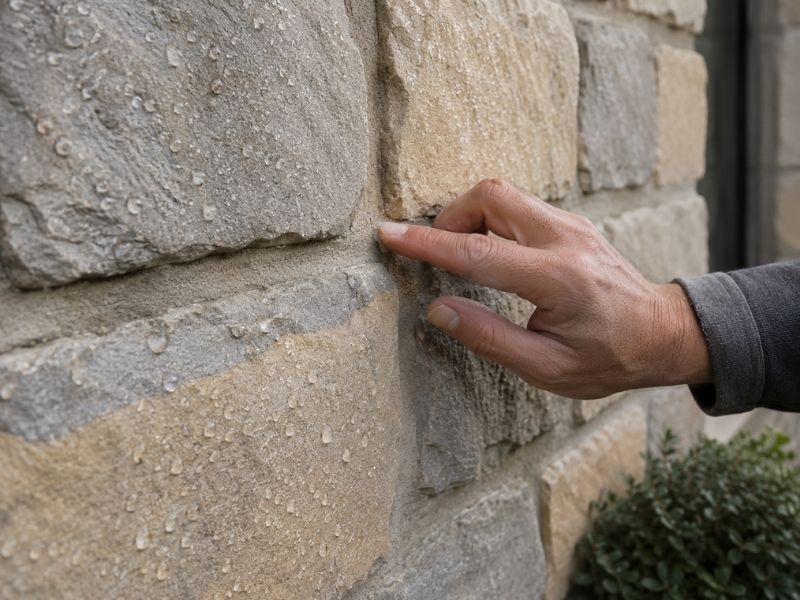
The application of a consolidant, a water-repellent or a protective oil reduces water absorption and facilitates the preservation of stone and terracotta. However, no treatment completely prevents the action of rain, pollution, traffic or dirt.
Simple and regular maintenance makes it possible to detect wear in good time and extend the durability of the protection.
Regularly check the surface
On exterior facades, walls and pavements, it is advisable to check:
The lower parts of the walls, crowns, sills, plinths and encounters with the pavement are usually more exposed and require special attention.
Clean with gentle methods
Dust and surface dirt should be removed with soft brushes, suction or low-pressure water, provided that the condition of the stone allows it.
The following should be avoided:
When verdigris, microorganisms, salts or stubborn dirt reappear, a new cleaning can be considered with Fakolith’s FK-12 detergent cleaner, adjusting the dilution and the procedure to the condition of the substrate.
After cleaning, the surface will need to be rinsed and dried completely before renewing any treatment.
Maintenance of walls treated with Fakolith
In consolidated and waterproofed walls, special attention must be paid to the condition of the joints and the entry of water at singular points.
Water repellent does not replace the repair of:
When the wall begins to absorb water more easily, it should be checked whether it is necessary to renew the water-repellent protection with FK-7. Before doing so, the base must be clean, dry and sufficiently cohesive.
If dusty areas or material losses reappear, another layer of sunscreen should not be applied directly. First, it will be necessary to review the origin of the deterioration and assess a new sanitation or consolidating treatment.
Maintenance of Protected Stone and Terracotta with OSMO
On floors and surfaces treated with OSMO Stone and Terracotta Oil or OSMO Colourless Concrete Oil, stains and spilled liquids should be removed as soon as possible.
Protection may be renewed when it is observed that:
Before applying a maintenance coat, the surface should be clean and completely dry. The product will be spread in a very thin layer, avoiding accumulations and removing any excess.
On surfaces subject to traffic, renovation may be limited to worn areas, provided that a pre-test is carried out to check the uniformity of the finish.
There is no single periodicity
The frequency of maintenance will depend on:
For this reason, it is preferable to review the behavior of the surface instead of establishing an automatic renewal every few years.
The clearest sign that a protection needs to be checked is that the stone or terracotta easily absorbs water and dirt again.
Is it mandatory to always clean with FK-12?
No. Fakolith’s FK-12 detergent cleaner is recommended when the stone has greenery, microorganisms, salts, contamination, adhering dust or persistent dirt.
If the surface is new or clean, firm and free of contaminants, it may not be necessary to use it. In any case, before applying the protective treatment, the stone must be completely dry and retain its absorption capacity.
What is the difference between consolidating and waterproofing a stone?
Consolidation and waterproofing serve different functions:
A degraded wall may need both treatments. Applying only a water-repellent will not recover decomposed stones, loose mortars, or eroded joints.
Can the treatment change the color of the stone?
It depends on the product, porosity and finish of the stone.
Fakolith mineral treatments must be absorbed by the substrate without leaving any surface residues. LG Multilithium can be applied lightly pigmented in Earth tone, depending on the needs of the wall.
OSMO oils are colorless, but they can intensify the natural tone of stones such as limestone, sandstone, slate, travertine, granite, or terracotta and provide a slightly satin finish.
Therefore, a test should always be carried out on an inconspicuous area before treating the entire surface.
Can the treatment be applied on wet stone?
No. The surface must be completely dry before applying LG Multilithium, FK-7 or OSMO oils.
Retained moisture can hinder penetration, cause differences in finish, and reduce treatment effectiveness. In addition, if there is a filtration, rising humidity or continuous entry of water, its origin must first be resolved.
Does a water-repellent replace the repair of seals?
No. Water repellent helps reduce water ingress, but does not rebuild open, eroded, or volume loss joints.
When the joints are very deteriorated, the most complete solution will be to clean them up and fill them with a compatible lime mortar. If the existing joints are preserved, it must be checked that they maintain sufficient stability before consolidating and waterproofing the wall.
Properly protecting a stone or terracotta surface isn’t just about applying a water-repellent product. The treatment should be chosen according to the condition of the support, its absorption capacity and whether it is indoors or outdoors.
When a wall has weathered stones, loss of cohesion or eroded joints, it will be necessary to act through a complete protocol of sanitation, cleaning, mineral consolidation and waterproofing. In these cases, the system recommended by Fakolith allows the support to be prepared with FK-12, improve its stability with LG Multilithium and reduce the ingress of rainwater using FK-7.
If the stone or terracotta is stable and in good condition, an impregnation protection can be used. OSMO Stone Terracotta Oil is intended for exterior surfaces, while OSMO Colorless Concrete Oil is used on stone, concrete and other absorbent mineral bases indoors.
In all cases, the surface must be firm, clean, dry and prepared to absorb the treatment. It is also essential to carry out a previous test, especially on limestone, sandstone, travertine, granite, marble, slate, artificial stone and terracotta.
Diagnose, prepare and protect: these three phases allow the stone to be preserved while respecting its texture, colour and natural appearance.
At RedVerde we can help you assess the condition of the surface and choose the most appropriate protocol for each façade, wall, pavement or decorative element made of stone and terracotta.