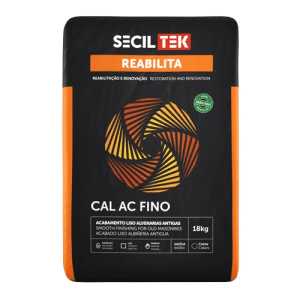
1. Lime is permeable to water vapour.
In other words, vapour can pass through it in a way that does not happen with denser materials such as cement or synthetic polymer-based skim coats. This allows buildings to breathe, so that when moisture forms, it can escape. And that matters because moisture, water in effect, is the enemy of all natural materials such as stone, wood and iron. Lime should be the first choice when the aim is to ensure that a building keeps its structural integrity and stays protected for many years.
This means that lime is good at absorbing and releasing moisture, that is, it can act as an environmental humidity regulator, exerting natural control over it, especially indoors, removing moisture from the air when there is too much and releasing it when the air becomes very dry, which makes living conditions more pleasant.
2. No condensation.
Because moisture is not building up in rooms when lime is used in construction, condensation does not build up on the surface of walls, which can lead to the growth of mould, something that is not only unsightly but can also release spores that are unhealthy to breathe. This is important for maintaining good indoor air quality in your home, especially if someone suffers from conditions such as asthma or allergies.
3. Lasting strength and adhesion.
Since one of the properties of lime is that it is made of very fine particles, much smaller than those that make up cement, it is very ""sticky"". This means it penetrates the small spaces on the surface of other materials, allowing it to bond to them extraordinarily well, for lasting adhesion.
4. It is flexible and deformable.
Since lime is a ""flexible"" building material that gives a little when a building moves, it is far more ""forgiving"" than denser cement materials, which can crack, deform or split, even with a little ground movement, or swell. It is also safer for adjacent materials, since lime causes no physical damage to the materials it touches, something that can happen when overly strong cement-based mortar mixes meet wood, iron, gypsum and so on.
5. Lime endures.
The longevity and good ageing of this material are very high, since surfaces and materials made with lime become stronger over time through carbonation and through the formation of calcite crystals that form in lime-rich environments, something that does not happen with cements.
But for evidence of the enduring properties of lime, consider the Pantheon in Rome, whose concrete dome of earth and lime not only spans 43 metres with no reinforcement of any kind, but was built almost 2,000 years ago. Closer to home, the churches, cathedrals and buildings from the first third of the twentieth century and earlier are all made with lime.
6. Lime is eco-friendly.
It is a material with a low carbon footprint. Not only does it absorb potentially harmful carbon dioxide from the atmosphere, but the amount of energy required to produce it in the first place, that is, the embodied energy, is enormously lower than that required to produce cement. And because it can be produced on a small scale, there is less impact on the local production area. It is also safe for the environment: lime is a natural material, it does not ""leach"" harmful chemicals, so unlike many more synthetic products it can be used near watercourses with no risk of harming wildlife or habitat.
7. It combines well with other materials.
Because lime bonds well with many things, both natural and recycled material can easily be incorporated into lime mixes, making it possible to obtain insulating and/or heat-reflective compounds by adding hemp, cork or recycled glass beads. Likewise, all natural limes and cements are compatible and can be mixed with one another.
Among its many uses, it is worth noting that it can also be incorporated into modern, effective building systems such as ETICS, where a lime skim coat is used as the finish over an insulating layer of natural cork or wood fibre on the existing surface.
8. It is easy to work with.
Despite the poor reputation some have tried to give it, lime is an excellent material to work with on site. Lime mortars and lime applications stay smooth and malleable, even when applied over porous blocks. This ""workability"" helps enormously in ensuring that joints are full and bonds are good, which is essential to good workmanship. Beyond that, this ease of working also means that aggregates of various sizes can be added to the lime mix to improve performance further and create different appearances.
9. Disinfectant, bactericidal and antiseptic.
Because it is caustic, given its high pH, lime has bactericidal and disinfectant qualities, especially when used as limewater, but the same is true of lime mortars, lime mixes and lime fillers. This means it will resist the build-up of moulds that can lead to breathing difficulties, creating a healthier living environment and making lime an ideal material for construction.
10. Lime is autogenous.
Which means it can heal itself. While movement in ""rigid"" cement-bonded buildings tends to produce cracks, the same movement in buildings where lime is used produces many fine cracks. When water penetrates them, it dissolves the ""free"" lime it finds inside, depositing it where it is needed as the water evaporates. In this way, lime seals and heals itself.
11. Lime blends into the landscape.
Lime is perfect for creating an understated finish that fits naturally into a locality in a way that is difficult or impossible with more contemporary products. It has the ability to age attractively and create beautiful patinas that blend into the landscape and the urban fabric, enhancing the surroundings. This can be important when you are trying to meet local planning requirements, or to create an image that is sympathetic to a local identity.
12. A beautiful natural finish.
Lime as a surface finish is aesthetically pleasing, with a more ""natural"" look that comes from the double refraction of light through the calcite crystals present in it. This creates a softer texture than that obtained with ""harder"" cement-based products, and it can complement the appearance of contemporary or traditional buildings. With lime, you also get a visual finish that is unique to every application, with the surface rapidly developing a distinctive ""patina"" that has a translucent sheen, something seen, for example, in the beautiful buildings of Venice.